
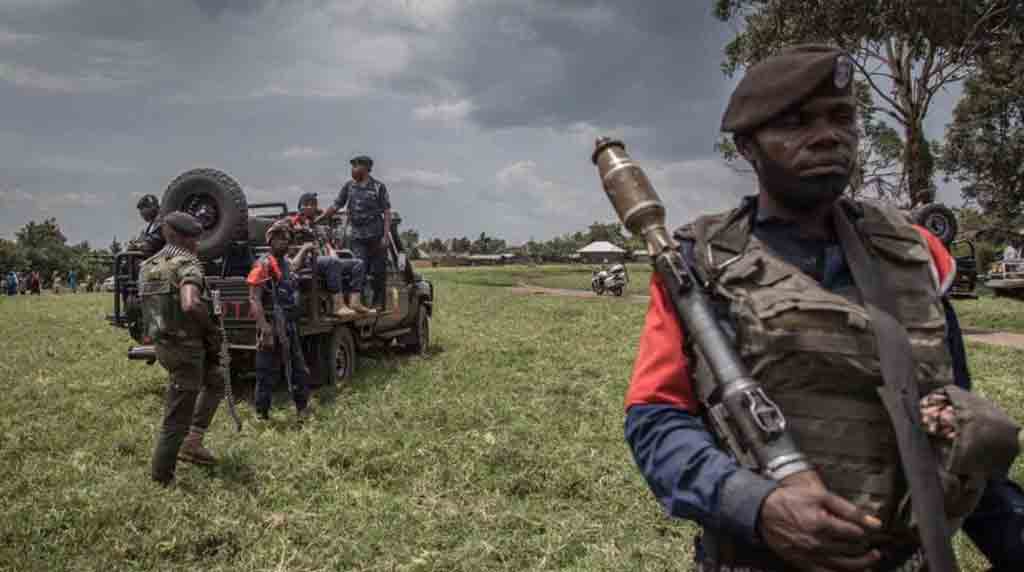
In January the BBC reported that up to 300 mercenaries, mostly Romanian nationals, had been captured by the M23 rebels and transferred to Rwanda near the eastern city of Goma in the Democratic Republic of the Congo as they were fighting on the side of the Congolese government. These Romanian mercenaries are thought to have been paid around $4000 per month for a combination of active fighting and military training roles within the DRC’s army. It is believed that these individuals were employed in the group Asociatia RALF, led by commander Horatiu Potra, who like some others in the group has experience fighting in the French Foreign Legion. It is Potra’s recent high profile that has seen him caught up in the electoral scandal surrounding Georgescu.
The use of mercenaries and private military companies has long been complicated. With hidden networks between countries and financiers, military companies’ dubious connections to causes being fought for often do not align with national alliances. The report evidenced army instructors’ poor leadership of the Asociatia RALF group. Compounded by the lack of adequate military experience of many of the group’s members, the group has been largely ineffective in its role in the Eastern DRC.
There is one motivation for mercenaries that remains clear: money. Mercenary groups have a long history of fighting conflicts on behalf of any cause or side for financial gain, rather than ideological motivations. It has often been the case that mercenary groups turn on their clients, one such example being during the Thirty Years War, 1618-1648, after missed payments. Over time, the use of mercenaries has declined in the face of nationalism and increasing state powers, with the majority of post-18th century conflicts being international, rather than intra-national.
The infamous Russian Wagner Group is one example of a somewhat successful mercenary group with deep connections to the military regimes in West Africa, after the recent removal of French military presence. The group mobilised several thousand troops in Ukraine on behalf of the Kremlin, until the death of its commander, Prigozhin, following the group’s failed uprising against the Russian government in 2023: a dramatic spectacle not seen by mercenaries since the wars in the 17th century.
The case of Asociatia RALF has been no different to these historic examples, with mercenaries attracted by lucrative high salaries, these being significantly higher than those offered by domestic armies. Governments such as that of the DRC view the cost of employing mercenaries as a beneficial investment. Some private military groups have the ‘selling point’ of being trained by highly-developed militaries, like the French Foreign Legion, and have reliable equipment. Furthermore, mercenary commanders only require financial incentives to fight, and unlike domestic fighters, are not influenced by the politics of local government or military; this is especially important where corruption and military coups have historically been a problem.
However, this is not without exception, and mercenaries have not been immune to ideology and international politics. During both the Rhodesian Bush War (1964-79) and the Spanish Civil War (1936-1939), mercenaries, especially foreign mercenaries, were notably political, with many joining factions in specific combat groups for primarily politically-motivated reasons. Further examples of this can be seen with the Republicans’ famous International Brigades and the fascist ‘Greenshirts’ of the Irish Brigade on the side of the Nationalists.
Today modern mercenary groups appear as complicated and well-connected as ever. Before countries had elaborate state bureaucracies, rulers relied on flexible combat groups that did not require complex conscription levies to be issued around the country, in this way, keeping the nobility at bay with the use of foreign troops. In the present, private military companies are equally influential and versatile, particularly the Wagner Group, which operates with considerable influence and oversight in partnership with regimes in West Africa, after the many military coups recently in the area.
Although private military companies appear little more than remnants of historic mercenary forces, they are politically well-connected groups that transcend regional and national jurisdictions in an increasingly globalised and transactional world. While they play an important role in the ever-changing geo-politics of today, mercenaries operate with as much elusiveness as they have done historically.

 PolSoc Paper