
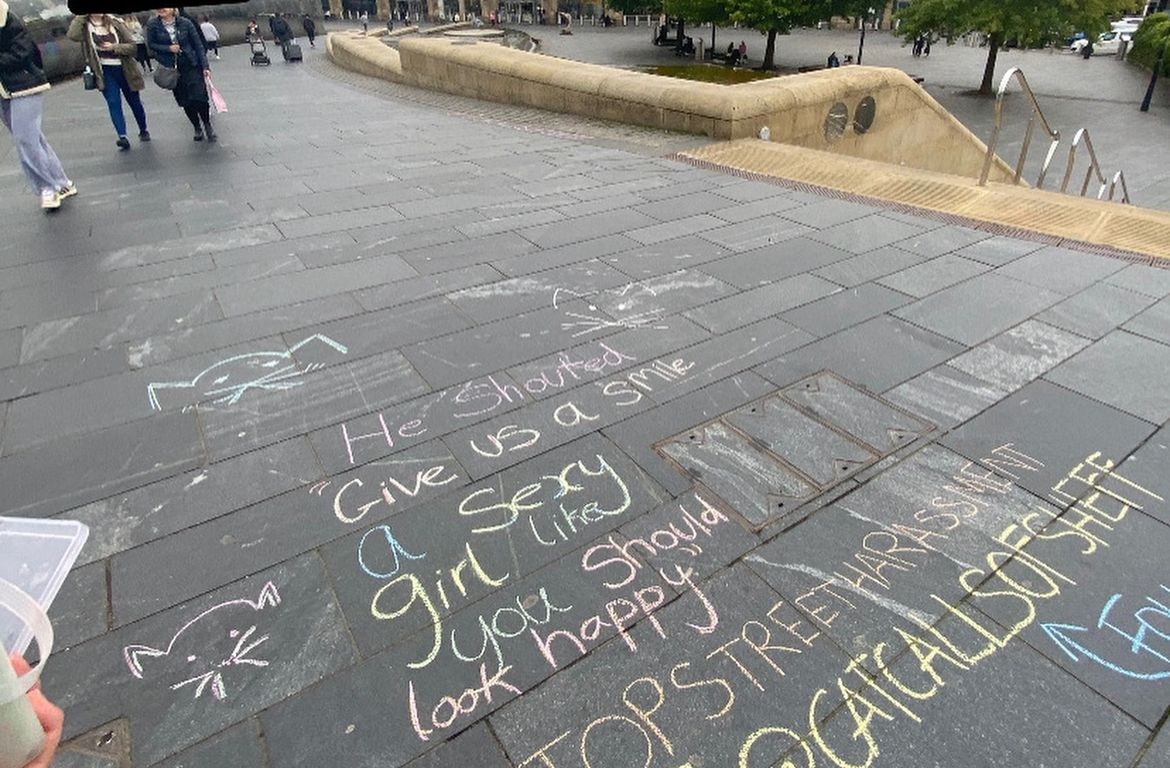
What is Catcalls of Sheff?
Catcalls of Sheffield runs as one part of the global collective of Catcalls accounts, which are all affiliated with the Chalk Back movement which began in New York in 2016. Each group tailors its campaign towards the needs of its city. Catcalls of Sheffield receive reports of harassment here in Sheffield and chalk the details on the sites where they happened.
The organisation is not affiliated with the University of Sheffield, partly to ensure that non-students feel able to submit their experiences as part of the campaign.
Who runs the organisation in Sheffield?
Catcalls of Sheffield was founded by two students here at the University of Sheffield, Flo and Babhravi, who primarily run the organisation. However, the organisation also trains volunteers to share the workload, and bring different expertise to large-scale projects.
Why did you both feel the need to start Catcalls of Sheffield?
We had known about the New York account for a number of years. The problem of harassment is rife and we felt that action needed to be taken, and that this action had to be visible and physical to be impactful.
Our campaign has been very fulfilling for those involved, because we feel that we are making a real impact. Catcalls of Sheffield shows the collective effort needed to address such a widespread issue, and the importance of grassroots campaigning.
How does Catcalls of Sheffield operate?
We chalk anonymous reports from individuals of street harassment in Sheffield. We also have a website we continually update with educational resources on harassment. We are also looking to run a photography exhibition with a local art collective to highlight the problem of street harassment.
We are currently running a campaign on the nightclub ‘Corporation’, discussing the way the security industry works at clubs and events, with a view to making nightclubs safer. We are also producing a report on how to make Sheffield a safer city.
Ultimately, we hope to operate on a more national level, sharing resources and the knowledge we have acquired through establishing and running Catcalls of Sheffield. Although, all of this campaigning has to be balanced with our degrees, as it is a huge time commitment.
You have already mentioned the time commitment, are there any other challenges you face running your campaign? How are you widening the campaign despite these?
The workload is a challenge, but we are working on this by delegating tasks to other volunteers. As well, because a lot of our work is location-based, the summer holidays have made it difficult for us to keep up with chalking, because a lot of volunteers do not remain in Sheffield for the summer. Another problem with this is that the weather can make it much harder to chalk, so in this time, it is important that we work on other areas of the campaign.
Another issue we face is a lack of funding, but we have set up a Go Fund Me to generate funds to cover our long-term costs, such as the website we have just launched, and short-term costs like room hire for training and events. Activism is an expensive thing, and so we need to invest time in sustainable financial planning to continue our campaign.
How can people get involved in your campaign, and how can they reach you?
A really crucial way that people can get involved is through donations. These can be financial donations, or sharing specialist knowledge on any areas of the campaign. We are taking things day-by-day, but people giving their time and money is a real priority to keep operations running, and any help is really appreciated.
People can volunteer with us in a number of capacities. We obviously need working groups of volunteers to do the chalking, however, people can also help with community event planning, art and design for the campaign, photography and article-writing. Outreach to other organisations and individuals is also a real focus to expand our knowledge and influence.
All volunteers have to go through training, and it is very important that anyone wishing to volunteer can see the bigger picture – an end to harassment, and a world order that enables it. This is not a goal shared by the University, which lacks any meaningful support systems for students. This is one reason why we do not want any affiliation with such a problematic institution.
We can be reached via our email, catcallsofsheff@gmail.com or on Instagram and Threads @catcallsofsheff . This is also how people can submit reports of harassment.
We also have a brand new website with resources on our campaign and the topic of harassment: www.catcallsofsheff.org
What do you hope readers take from reading this interview? Aside from being encouraged to volunteer with Catcalls of Sheffield.
The idea that harassment is not something that is a constant or a given – that there is another option. It is a big task, but in any form of activism, you cannot think that way or you will lose hope. People need to have faith that harassment can be combated, because this will make it possible, and is what makes organisations like Catcalls of Sheffield possible.

 PolSoc Paper