
UK universities are in deep trouble, courses are being cut and staff are being made redundant. Since the capping of tuition fees at £9,250, universities have relied on enrolling international students who they can charge much higher fees. The pandemic and anti-immigration policies, which have led to a fall-off in international fees, have tipped the unsustainable model of university expansion into crisis.
The Higher Education minister, Jacqui Smith, has repeatedly said that there is no new money for universities and that some will have to be allowed to fail. This has not changed the fact that the finances of universities need to be shored up. Peter Mandelson, one of Blair’s spin doctors, is pushing the government to raise university tuition fees by 2.5% now in-line with inflation. Universities UK (UUK) has proposed the much harder line of increasing tuition fees to £13,000, the figure they put on the base cost of providing an undergraduate degree programme. UUK says 93% of all funding for teaching comes from tuition fees.
This seems to have had some impact with the Education Secretary, Bridget Phillipson. Phillipson previously stated that the government would not raise tuition fees, but is now hinting at an increase from £9,250 to £10,500 over the next five years, the biggest since the coalition tripled fees to £9,000 from 2012-3. Labour might reintroduce maintenance grants for the poorest students to somewhat cushion the blow. But those poorest students will be saddled with over £30,000 debt even before interest has accumulated, which it now does while students are studying, and at a higher-than-ever level. It is likely that there will be an announcement about Higher Education in the next budget on 30th October.
Keir Starmer was elected as leader of the Labour Party on a pledge which said: “Labour must…end the national scandal of spiralling student debt and abolish tuition fees”. The fact is that there is more than enough wealth in society to pay for Higher Education and public services. In the European Union most universities have secure funding from the state and lots of countries have free education. Tuition fees only started in 1998 in the UK.
The university crisis has shown that reliance on fees and universities competing to recruit more students is an irresponsible way to run education. A democratic society depends upon education at all levels. It allows us to discuss and think creatively and critically about the world, and gives people the means to learn, discuss and teach. The costs should be borne by those who have the means to pay.
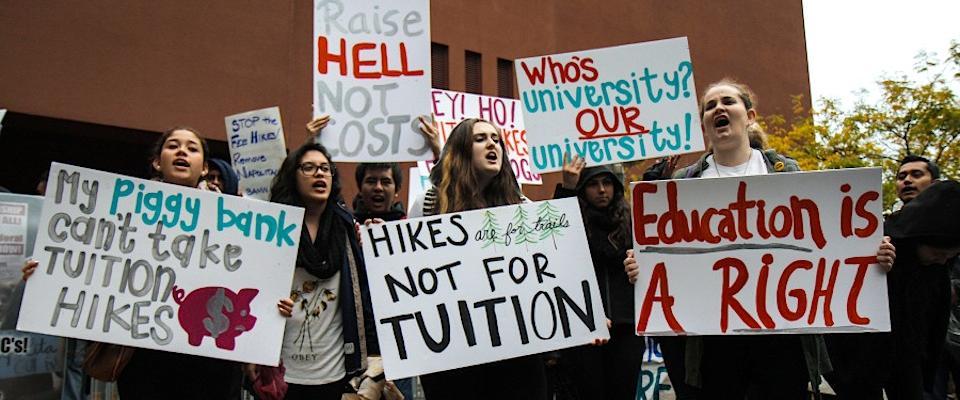
Raising tuition fees will be deeply unpopular with students. The response so far from the student movement has been weak. The National Union of Students (NUS) has put out a weak statement. Even worse than this half-hearted response, most individual Student Unions have said nothing. If we go on like this, the change will go through effectively unchallenged.
The simple fact is student organisation is inadequate to fight the fee increase. The student-left is at best disorganised and fragmented, and in many places does not exist in any coherent sense. We need to rapidly organise united anti-fee campaigns on all campuses. In Sheffield, where organisation is stronger than elsewhere, we can act as a model for what a strong anti-fee campaign should look like.
An effective campaign would bring already existing political societies together as well as politicise new students; it would work for demonstrations, direct action, and occupations. It would reach out to other campuses where the student movement is not yet organised. Holding planning meetings, running stalls, and reaching out to as many students as possible.
The campaign would pressure our Student Union and the NUS into opposing the fee increase with full-force and putting their financial resources behind the campaign. It would link up with campus trade unions fighting back against wage freezes, job cuts and more outsourcing. As well as on the streets, it would work with activists on the Labour-left to express and amplify the struggle through the party. To force the government to back down, we must attack it on every front. The campaign would be an alliance of all those who believe that education should be open to all as a human right, not a privilege open to a minority based on wealth.
 PolSoc Paper