
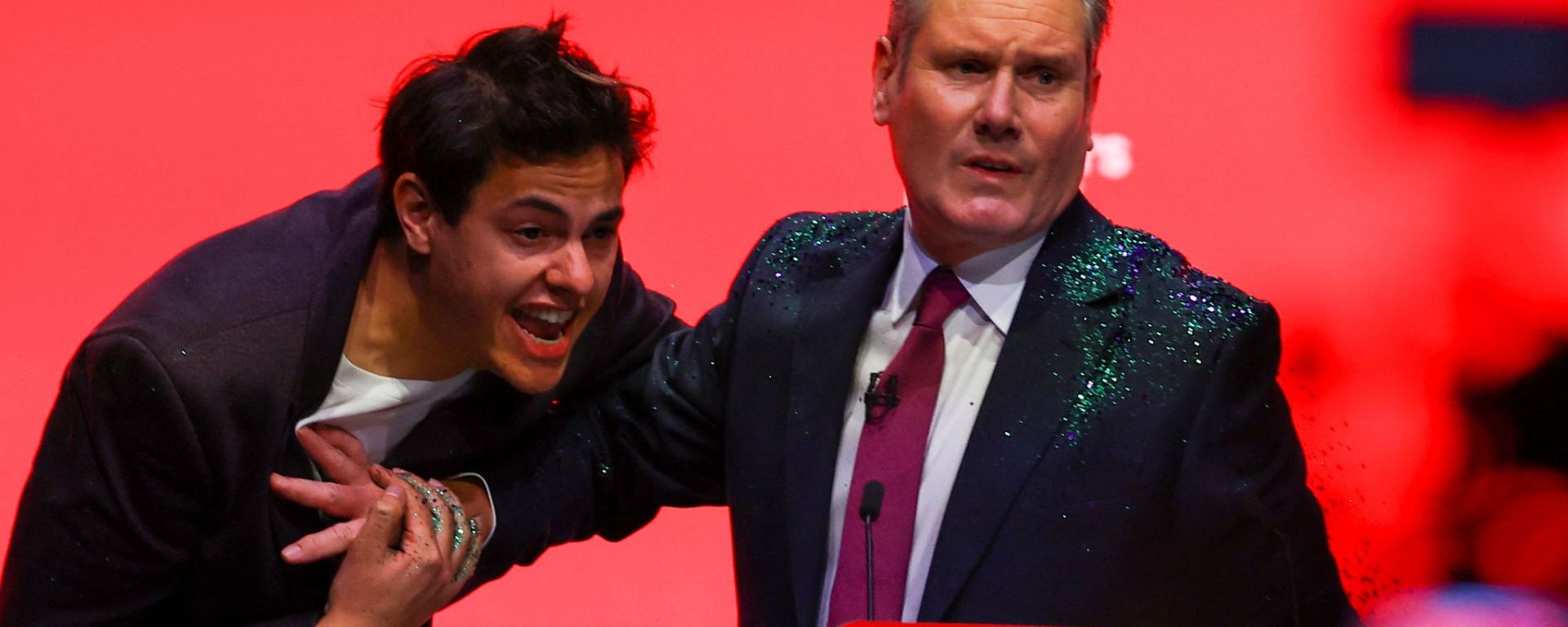
The countdown clock to the predicted 2024 autumn general election is ticking down to its final hours. Party conferences are now finished and it is expected that party leaders have delivered their final speeches to their supporters. Whilst Priti Patel’s karaoke rendition of ‘Angels’ wasn’t enough to lift the flat atmosphere at the Conservative conference, Starmer’s glittering speech topped off the week with optimism in the Labour camp.
The September reshuffles have come and gone, and strategising for the general election will now be underway. Despite currently occupying government, the Conservatives will feel at a disadvantage with their last 18 months being dominated by sleaze, turbulent leadership and economic woes.
Since returning from the summer recess, Sunak has adopted a more aggressive rhetoric. He has attempted to divert the political debate away from the economy and public services, instead steering it towards divisive social issues such as immigration and transgender rights[1]. This strategy will look to align the Conservatives with “middle England” and depict the Labour Party to be the “out of touch liberal elite”. During the Conservative conference, Sunak tried to distance himself from the last 13 years of Conservative rule by declaring “It is time for change”[2]. Whilst the Conservative’s strategy is as surprising as it is decent, Labour’s strategy is slightly more fascinating.
Since being elected in 2020, Starmer has been clear in his aim to “make Labour electable”[3]. He intended to achieve this with a three-step plan that involved erasing antisemitism from the party, holding the Conservative government to account, and establishing a vision for Britain. With accusations of antisemitism in the rear-view mirror, and the government in disarray, the shift to the centre is all but complete for Starmer. The move to the centre has not come without in-party-opposition and has created a disconnect between party members and the parliamentary leadership.
Furthermore, the execution of the last, and most essential, stage of his plan has evoked a large amount of indifference from the electorate. Despite a convincing 18% lead in voting intention polls [4], underwhelming gains in the May local elections reveal a telling story of a lack of enthusiasm for Labour and the Starmer project.
I wrote the main bulk of this article prior to Labour’s victories in the Tamworth and Mid Bedfordshire by-elections. I was riddled with concern that my observations were misguided and no longer relevant, however upon further analysis Starmer’s significance in the wins diminish. By-elections are notorious for acting as a protest vote against the sitting government and not being a representative indicator for general elections. An accumulation of factors such as the Reform party splitting the right-wing vote, the nature of departure from the previous Conservative MPs, and large falls in voter turnout compared to the 2019 General Election (28.4% drop in Tamworth, 29.7% drop in Mid Bedfordshire[5]) outline reasons for the swing.
Although Sunak’s approval rating currently sits at 34% (lowest since being elected) [6], Starmer’s rating is only 4% higher [7]. A word cloud featuring on ‘Sunday with Laura Kuenssberg’ revealed that words most associated with the current Labour leader were “Nothing”, “Don’t know”, and “Not sure” [8]. These bland expressions reflect the lack of imagination in the ideas being expressed by Labour.
In an attempt to “make Labour electable” [9], Starmer and the Shadow Chancellor of the Exchequer, Rachel Reeves, have opted for fiscal conservatism. This has involved scrapping previous spending commitments such as investment in green energy, renationalisation of utilities, and abolishing tuition fees. As we find ourselves currently living through the cost of living crisis, it is understandable that Labour have decided to project themselves as the party of financial stability. However, long-term issues such as rising inequality, deteriorating public services, and mounting distrust in the political establishment have seen a growth in support for drastic policies. Nationalisation of key industries[10], electoral reform [11], and a wealth tax[12] have been promoted by those on both sides of the political spectrum. Utilising the electorate’s desire for change, a weak opposition, and a comfortable poll lead, Starmer can afford to have a bolder plan for Britain.
After the Second World War, it was Labour under Clement Attlee who won the election by promising a post-war future built on the foundations of hope and fairness. Meanwhile, New Labour were elected for their intentions to modernise Britain with progressive policies, not just because they were in opposition to a chaotic Conservative government. Similarly, former Labour leader Ed Miliband regrets not being “radical enough”[13] reflecting on the 2015 loss in an interview with British GQ. Starmer must learn from his predecessors on building a campaign on hope and reducing the economic gap in society.
It could be argued that we are still a year away from the election, and recent pledges of large-scale building plans and education reform could indicate future ambitious policies to address the country’s shortcomings. However, consistent U-turns on issues such as future relations with the EU and constitutional reform illustrate a lack of decisiveness and coherence behind Starmer’s ideology. This approach has come back to haunt Starmer as his change in stance on whether Israel holds the right to restrict water and electricity to Gaza has sparked outrage in the Musilm community and anonymous members of the shadow cabinet. I was struck by comedian Steve Coogan’s criticism that Starmer “licks his finger, sticks it up in the air, and sees which way the wind (political debate) is blowing”[14]. Accordingly, voters may be apprehensive of Labour and tempted to turn to alternative options such as the Liberal Democrats, the Green Party, or abstention altogether.
It’s hard to imagine a scenario where Labour isn’t the largest party after the next election. However, if Starmer continues to be indecisive and/or offers sterile solutions to the same old problems, Labour may well find itself stuck in a minority government.
[1] Pettitt, J. (2023). Rishi Sunak aims to divide and rule after poll setback. [Online]. The Times. Available at: https://www.thetimes.co.uk/article/rishi-sunak-aims-to-divide-and-rule-after-poll-setback-rl0tqjqhw#:~:text=Rishi%20Suna [Accessed 16 October 2023].
[2] Robinson, M. (2023). Rishi Sunak’s speech in full: ‘It is time for a change. And we are it’. [Online]. The Telegraph. Available at: https://www.telegraph.co.uk/politics/2023/10/04/rishi-sunak-tory-party-conference-speech-in-full/#:~:text=And%20we%20are [Accessed 16 October 2023].
[3]Woodcock, A. (2021). Starmer: I’m ready to break pledges to make Labour electable. [Online]. The Independent. Available at: https://www.independent.co.uk/news/uk/politics/keir-starmer-labour-conference-pledges-b1928605.html#:~:text=Keir%20Starm [Accessed 16 October 2023].
[4] Politico. (2023). National parliament voting intention. [Online]. Politico. Available at: https://www.politico.eu/europe-poll-of-polls/united-kingdom/ [Accessed 17 October 2023].
[5]Giddings, A. (2023). Labour overturn 19,000 Tory majority for ‘incredible’ Tamworth win. [Online]. BBC. Available at: https://www.bbc.co.uk/news/uk-england-67165541 [Accessed 28 October 2023].
[6] Politico. (2023). National parliament voting intention. [Online]. Politico. Available at: https://www.politico.eu/europe-poll-of-polls/united-kingdom/ [Accessed 17 October 2023].
[7] Politico. (2023). National parliament voting intention. [Online]. Politico. Available at: https://www.politico.eu/europe-poll-of-polls/united-kingdom/ [Accessed 17 October 2023].
[8] Harris, K. (2023). Keir Starmer faced with word cloud of what voters think of him in excruciating B. [Online]. Express. Available at: https://www.express.co.uk/news/politics/1821272/Keir-Starmer-BBC-interview-labour [Accessed 17 October 2023].
[9] Woodcock, A. (2021). Starmer: I’m ready to break pledges to make Labour electable. [Online]. The Independent. Available at: https://www.independent.co.uk/news/uk/politics/keir-starmer-labour-conference-pledges-b1928605.html#:~:text=Keir%20Starm [Accessed 16 October 2023].
[10] Gye, H. (2023). Majority of public including Tory voters want water and rail nationalised, poll. [Online]. INews. Available at: https://inews.co.uk/news/politics/majority-public-tory-voters-want-water-rail-nationalised-poll-2549628 [Accessed 17 October 2023].
[11] Simpson, I. (2022). Long running survey finds majority support proportional representation. [Online]. Electoral Reform Society. Available at: https://www.electoral-reform.org.uk/long-running-survey-finds-majority-support-for-proportional-representation/ [Accessed 17 October 2023].
[12] Smith, F. (2023). Three quarters of Britons support wealth taxes on millionaires. [Online]. YouGov. Available at: https://yougov.co.uk/politics/articles/45044-three-quarters-britons-support-wealth-taxes-millio?redirect_from=%2Ftopics% [Accessed 17 October 2023].
[13] British GQ. (2018). Alastair Campbell vs Ed Miliband on podcasts, Brexit, and bacon sandwiches. [Online]. British GQ. Available at: https://www.youtube.com/watch?v=XJQKbIu0zA0 [Accessed 18 October 2023].[14]Jaffer, K. (2023). Steve Coogan accuses Keir Starmer of waiting to see ‘which way the wind blows’ a. [Online]. Mail Online. Available at: https://www.dailymail.co.uk/news/article-12667921/Steve-Coogan-accuses-Keir-Starmer-Jeremy-Corbyn-attacks-Labour-leader. [Accessed 28 October 2023].

 PolSoc Paper